


Ground grid BG30
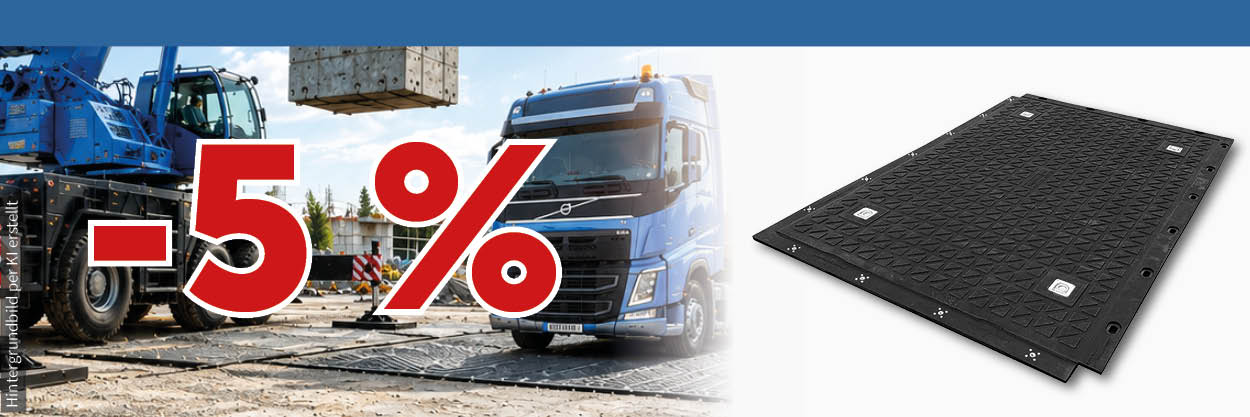
Save in November 5% when you buy our products with up to 200 t load capacity MegaTrack PRO heavy-duty road plate with fully integrated connection technology and load-distributing overlapping lips.
It is therefore particularly suitable for temporary use at high-traffic events such as festivals, as well as as a replacement location during the conversion of existing stations. Why are mobile radio trailers being used to build the 5G mobile network in Germany?
For this reference, our customer opted for the heavy-duty BG30 ground grid instead of concrete grass pavers. Just like concrete grass pavers, the plastic ground grid serves the same purpose. Compared to grass pavers, the ground grid is significantly lighter and faster to install.
The ground grid has 16 coupling elements, while the grass grid stone does not. Another advantage of the ground grid compared to grass grid stones is the soft, elastic, and dimensionally stable LDPE plastic. This plastic is capable of absorbing and releasing high loads and forces. The concrete grass grid stone is hard and porous.
In summer, the concrete of the grass pavers heats up through the wide, flat ridges, drawing moisture from the soil. As a result, the grass turns yellow and can burn. In winter, ground frost and trapped water in the concrete can easily cause the grass pavers to crack or even burst.
The plastic ground grid, on the other hand, is virtually invisible thanks to its thinner ribs and mesh walls. The smaller surface area is therefore less susceptible to heat buildup, especially since the plastic itself insulates rather than absorbs or stores solar energy. Thanks to these properties of the plastic ground grid, no moisture is drawn from the soil, ideal for maintaining a lush green lawn.
For all these reasons, the customer chose the BG30 soil stabilizing grid. Depending on the subgrade/substructure, the grid can withstand loads of up to 350 t/m² and is suitable for axle loads of up to 12 tons. This makes it possible to drive heavy vehicles over the vegetated grid without creating ruts or ruts.
The first steps involved removing the existing lawn and excavating it to create a stable base. Before laying the ground grids, the ground was then leveled, compacted, and sanded. All that remained was to fill the ground grids with soil and sow grass seed.
As you can see in the last pictures, a lush green lawn has been created. Vehicles can now drive over it without causing damage. Ruts and ruts are also a thing of the past.


