


s:tek high-performance ground protection mat
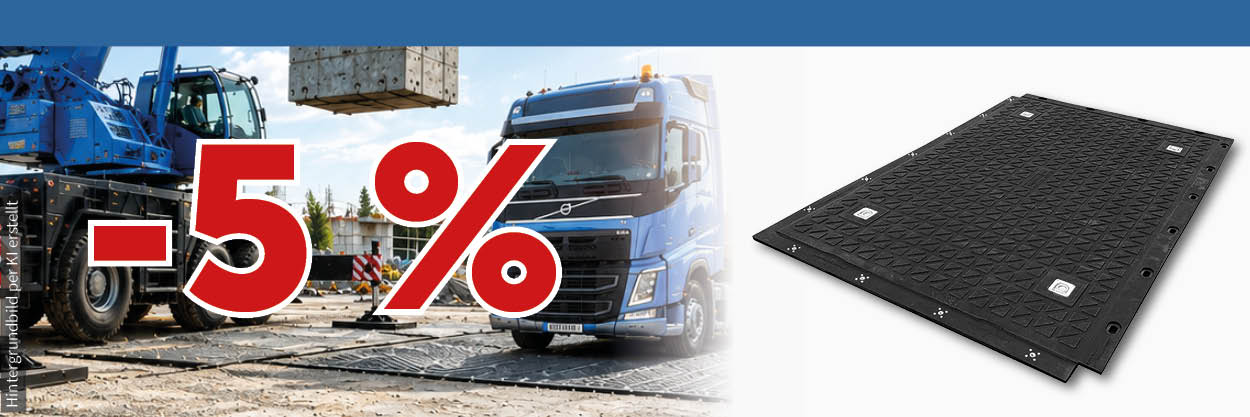
Save in November 5% when you buy our products with up to 200 t load capacity MegaTrack PRO heavy-duty road plate with fully integrated connection technology and load-distributing overlapping lips.
One of the most common applications for our s:tek high-performance ground protection slabs is temporary access solutions. Thanks to the freely selectable top and bottom profiles and their low weight, the ground protection slab is a safe choice for virtually any application.
Construction work has just begun on the "Photovoltaic Noise Barrier" pilot project along the A3 motorway between Aschaffenburg and Aschaffenburg-Ost. The pilot project aims to gain experience with an innovative solution for the interaction of noise protection and photovoltaics, in which the photovoltaic elements themselves perform noise protection functions.
Closing the gap between the existing noise protection structures with an approximately 890 m long and three m high noise barrier on the south side of the motorway will significantly improve the noise situation for residents of the Aschaffenburg districts of Damm and Strietwald. The north side of the barrier will have a highly absorbent surface to prevent noise reflections.
A medium-sized construction company from Aschaffenburg will be responsible for the construction, operation, and maintenance of the system for a period of 20 years. To facilitate the construction work, a so-called 4+2 traffic pattern will be implemented over a distance of approximately two kilometers, ensuring that three narrow lanes will continue to be available in each direction.
As you can probably imagine, a project like this sometimes requires heavy equipment. Of course, you don't want to risk damaging the road surface. Protecting the subsurface is therefore essential.


