


Ground grid BG30
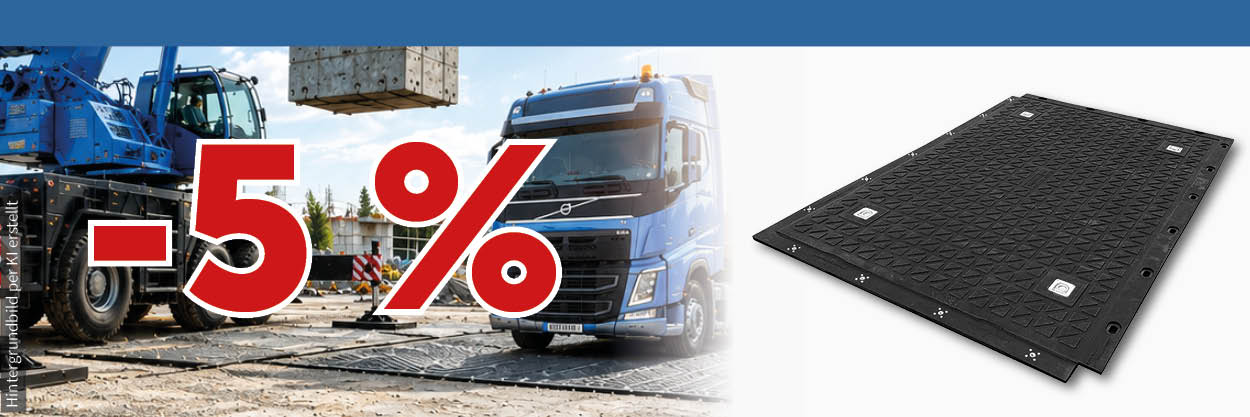
Save in November 5% when you buy our products with up to 200 t load capacity MegaTrack PRO heavy-duty road plate with fully integrated connection technology and load-distributing overlapping lips.
This customer project involved the construction of a new paddock for horses. After extensive product consultation and an exchange of information about the ground conditions, the decision was made to use the BG30 ground grid. Made of joint-friendly, soft, yet dimensionally stable LD-PE, our customer installed the ground grid in a minimal design with a separating fleece and without a substructure. Below is a report on the work carried out and the installation of the ground grids by our customer:
Hello Ms. Wagner!
As just discussed on the phone: here is a short summary of the paddock construction.
19.03.2015: Delivery of the ground grids BG30
March 21.03.2015, 150: Pushing out and leveling an area of XNUMX sqm using a mini excavator.
This area was previously partially paved with grass pavers. Otherwise, the subsoil was just dirt.
The prepared area was NOT leveled or anything similar. The TV110 separation fleece was simply laid on the soil, over which the mini excavator had previously driven several times to compact it.March 23.03.2015, 24,3: Delivery of XNUMX tons of cable sand and start of installation of the ground grids.
Cable sand (also known as silt sand) was used as the "base" for the ground grids. This has the advantage of compacting very well over time and becoming very hard. The disadvantage in summer or during dry periods: since the sand contains no large stones, it creates quite a dusty appearance in dry conditions and is also easily blown away by the wind. The sand was wheelbarrowed to the required location and then carefully poured onto the fleece, as otherwise the fleece would shift and the sand would no longer be where it should be.
The ground grids were laid "floating" on a layer of approximately 10 to 15 cm of cable sand. It should be noted, however, that it is recommended to compact the sand, at least in the critical areas (underground shelters), as it tends to give way under the weight of the horses, lifting the grids accordingly. Once the ground grids were laid on the cable sand, another 5 cm layer of cable sand was spread.
The space for the foundations of the shelter (5 foundations) was simply left free, i.e. the grids were simply removed at these points and then construction continued at the next location.
To finish off the paddock, grass grid stones were laid.April 28.04.2015, 30.04.2015: Completion of the paddock, as the third horse was due to arrive on April XNUMX, XNUMX, or rather, arrived!
Mucking out and maintaining the paddock is very pleasant and easy to manage. However, before winter, another layer of sand must be added to the 150 square meter area, as a lot of it was lost during mucking out and the wind blowing away the sand. So, 12 to 13 tons of sand (0/4 sand) will soon be added. This 0/4 sand is heavier, meaning it contains more coarse stones and will hopefully hold up longer in windy conditions.


